Paper & citation
The design and validation of ExoStack are described in the paper below.
The paper
ExoStack: A Modular and Reconfigurable Software Framework for Wearable Robotics Using ROS 2
Debadrata Sarkar et al.
arXiv preprint, 2026.
Read on arXiv User manual (PDF)
Abstract
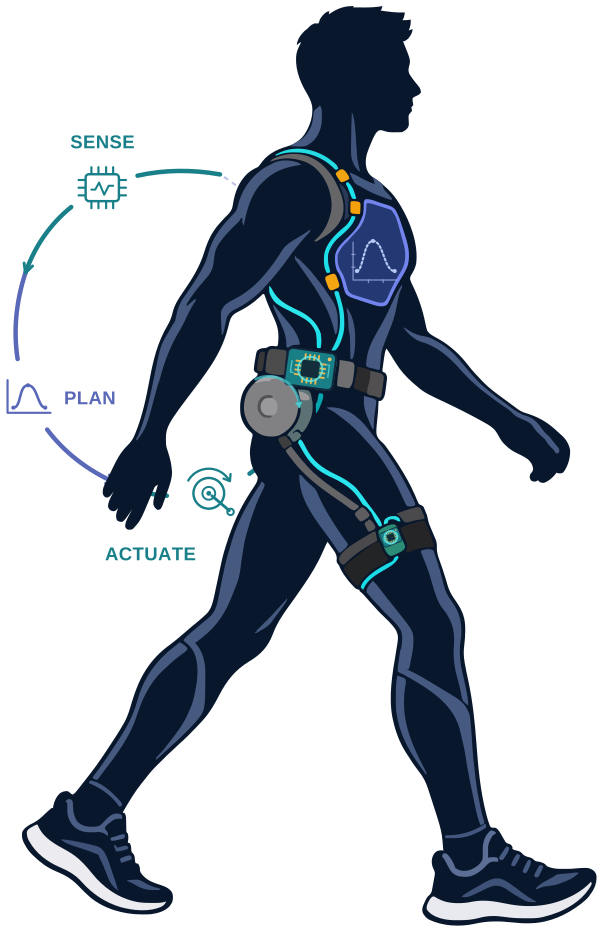
Wearable assistive robots, such as exosuits and exoskeletons, need software that reads many body-worn sensors, recognizes the wearer's gait, decides how much assistance to apply, and drives the actuators, often while an optimizer personalizes the assistance. This software is usually rewritten for each new device, which slows research and hinders reproducibility. We present ExoStack, a modular and reconfigurable software framework built on ROS 2 that provides this complete pipeline as reusable nodes exchanging data over topics. Its firmware library, ESA, turns body-worn microcontroller boards into micro-ROS hubs that publish synchronized sensor data and drive actuators. Its ROS 2 nodes, ExoCore, detect gait events, generate and execute assistance profiles, and run human-in-the-loop (HIL) optimization. Its graphical tool, PASE, configures, launches, and visualizes the stack. New sensors, actuators, and algorithms are added from templates without editing the core, and a new device, with more joints, both legs, or different hardware, is configured rather than coded. We benchmark ExoStack on three embedded computers and validate it on two pneumatic exosuits.
Cite ExoStack
@article{exostack2026,
  title   = {ExoStack: A Modular and Reconfigurable Software Framework for Wearable Robotics Using ROS 2},
  author  = {Sarkar, Debadrata and others},
  journal = {arXiv preprint arXiv:[ARXIV_ID]},
  year    = {2026},
  doi     = {10.48550/arXiv.[ARXIV_ID]}
}
Publications using ExoStack
- D. Sarkar, S. Chakraborty, S. Sen, S. S. Roy, and A. Arora, “SoftEXOwalk: A human-in-the-loop optimized soft exosuit for assisting knee flexion using sensorized pneumatic muscles,” IEEE Transactions on Medical Robotics and Bionics, 2026, doi: 10.1109/TMRB.2026.3722336.
Used ExoStack in your work? Tell us through GitHub Issues and we will list it here.